
ENTER YOUR EMAIL TO RECEIVE OUR WEEKLY NEWSLETTER
The Forced March
The exercise, near the end of basic training at Fort Gordon, Georgia, was brutal: a twelve-mile slog in full battle gear with temperatures over 100. But the author “wasn’t the hothouse flower” he’d thought he was.
. . . . . . . . . . . . .
My Vietnam War, 1966–1968, Article No. 5 in a Series
. . . . . . . . . . . . .
Not long after Sergeant Ruiz accused us of damaging his car, he vanished—poof, just like that. Sergeant Reilly stepped in and led the last two weeks of training. When I asked him what happened to his sharp-tongued colleague, he told me he’d been shipped out.
“Shipped out? Just like that, in the middle of training? It doesn’t make any sense.”
“Who says the Army makes sense?”
Who indeed? The whole time I was in uniform, the Army bewildered me—and most everyone else. Orders would crash down from the Pentagon like thunderbolts and send troopers into the void—without explanation, apology, or the chance of appeal.
This particular order pleased Charlie Company. The last thing we wanted was Sergeant Ruiz sniping at us while we prepared for the grand finale: the forced march, a twelve-mile slog in full battle gear through the camp’s vast woodlands.
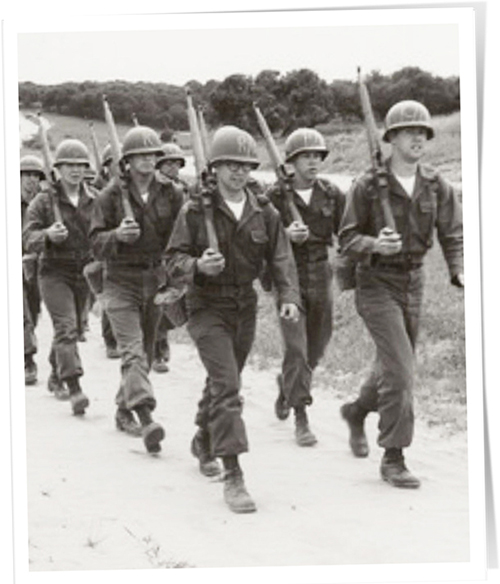 . . . . . . . . . . . . .
Marching in the Army. Photo: Abe De La Vina/Facebook.
. . . . . . . . . . . . .
The temperature surged past 100 on the big day itself. The Southeast had been baking all summer, but this was the absolute worst. You wilted; you sweltered; you schvitzed.
Assembled beneath the searing sun, Charlie Company was dripping wet even before our captain paraded in front of us. “All right, men, y’all had your salt tablets?”
“YES, SIR!”
“Canteens filled to the brim?”
“YES, SIR!”
“This is a march, not a walk. Understood?”
“YES, SIR!”
“No faking, no shortcuts, no talking. Understood?”
“YES, SIR!”
“If you sneak out early, your ass is grass. Understood?”
“YES, SIR!”
With that, we saluted, shouldered arms, and marched off into the pine barrens behind the firing range. My rifle (fortunately unloaded) bounced against my shoulder as I stomped down the trail. Left, right, left, right. Dust, sun, dust, sun.
Trapped and magnified by my battle helmet, the heat started getting to me. It slammed down from the sky and bounced back from the earth. My eyes burned with the sweat cascading off my forehead. Red spots pulsed in front of me. Heat was all there was; heat was all I was. But I kept on marching: left, right, left, right, dust, sun, dust, sun. Over and over, mile after mile.
It must have been two or three hours before I finally stumbled back into the barracks and collapsed on my bunk. I was whipped, but oddly elated. I’d made it. I wasn’t the hothouse flower I thought I was. The tedious drills and routines of basic training had done their job. I was in the best shape of my life.
Looking around, I noticed that most of the bunks were empty; I was one of the first to return. Taylor, the company wise guy, was another early arrival. A bull from the Bronx, feisty, funny and fit, he once did 1,000 sit-ups because we bet him 100 bucks he couldn’t. He guffawed and gave us the finger as he took our cash.
“So, where’s the rest of Charlie Company?” I asked.
“Passed out in a swamp.”
“Come on, man, get serious,” I said. Taylor was quite the storyteller. He spun freewheeling tales of brawls and hookups in a raucous world totally different from my artistic playground. I often wondered if any of his astonishing adventures had actually happened. In those pre-internet days, it was easy to claim all sorts of wild exploits and very hard to check them—especially in the Army.
“I shit thee not,” Taylor continued. “A whole bunch of guys collapsed after starting on the trail. I mean, what’s that? A soldier faints after only a few steps? That’s ridiculous.”
“It’s incredibly hot today, in case you haven’t noticed.”
“You’re a soldier; suck it up! Would you believe Reilly had to call in the MPs to scoop those losers off the ground and take them to the infirmary?”
“Wow, that sounds serious.”
“It’s pathetic! They couldn’t hack it! They dropped like flies, one right after the other.” He mimed shooting a rifle. “Bam! Bam! Bam!”
As we were talking, some of our buddies staggered in. Taylor turned around and stared at them coldly. “Well, well, look what the cat dragged in.”
“Can it, Taylor,” one of them muttered.
Taylor flashed a cheery smile. “Don’t have a can handy. Sorry.”
The trooper grunted and limped to his bunk.
Eventually the last of the guys arrived, tattered and weary. No one said a word. Some crawled into bed, while others peeled off their uniforms and went to the showers.
I decided to join them and wash off the stink and grime. Even in the shower room, the somber mood persisted. No one mentioned what we’d just gone through; no one asked where our missing buddies were. It was as if the whole march had never happened. I guess the experience was just too much for us—though we’d never in a million years admit it.
We dried off in silence and shuffled back to our bunks. To my surprise, a few guys got dressed quickly and rushed outside to call their families. I thought little of it at the time and buried my head in the pillow. Eventually, sleep came and gave me blessed relief.
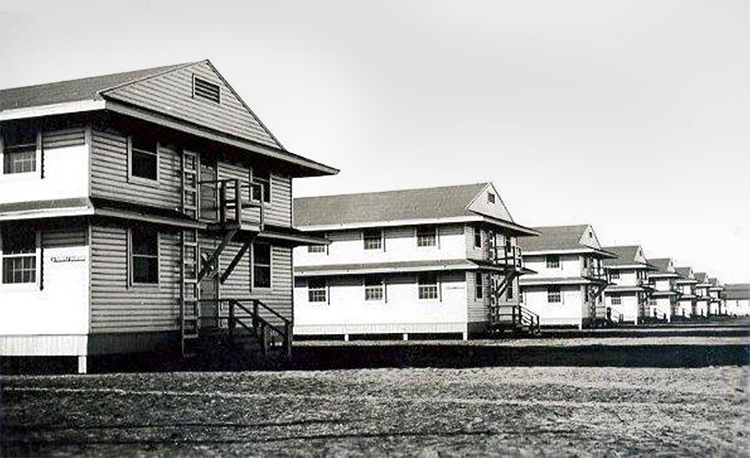
Barracks at Fort Gordon. Photo: Justiceomercy.com, from Frank da Cruz and Taipei Signal Army.
. . . . . . . . . . . . .
The next day, when the heat receded and we felt more human, we assembled outside to hear a report from our captain. He seemed unusually nervous.
“Men,” he said, “that was a tough march yesterday, and some of you had problems. A few of your buddies are still in the infirmary, but they’re gonna be just fine.
“Now, it’s come to my attention that some of you called your folks, and they called their congressmen, and… Well, we’re a democracy; it’s the American way. In any case, the Pentagon got your message loud and clear. General Richardson, our commanding officer, has sent down new orders, effective immediately.”
He took out a paper and read: “‘No march will be held when the temperature is over 85 degrees. All marches will have ten-minute breaks every hour. Salt-tablet consumption is mandatory and will be monitored by each commanding officer.’”
He put the decree back in his pocket. “That’s it, men. Company dismissed.”
As we headed back inside, I wondered if the new orders were a by-product of the widespread demonstrations against the war. Lots of draft-age kids were out on the streets shouting, “Hell, no, we won’t go!” The country was getting restless, and the Pentagon was scared.
I was stretched out on my bunk when Taylor stormed over. He was furious. “No marches when it’s 85 degrees? What kinda horseshit is that? It’s way hotter in Nam, ain’t it?”
“Yeah, it’s usually 100 or 110 in the summer.”
“How the fuck will we deal with it if we don’t march when it’s really hot?” he cried. “It’s war, not make-believe.”
“I know, but still, you gotta…”
“The first time these sissies get hot, they run off to Mommy and complain. And she calls her sissy congressman who needs Mommy’s vote, so he leans on the Pentagon and they’re sissies, too. They’re wimps, the whole damn bunch—fools! Fort Gordon’s not hot, man; Vietnam’s hot! It’s sizzling. It’ll burn you up in two minutes.”
“Yeah, but they gotta keep us safe.”
“They gotta win the war! Complaining about heat is kiddie stuff. War’s hardcore. We gotta fight like we fucking mean it.”
“Taylor, they’re just trying to protect us.”
“BUT THEY DON’T!” Taylor slammed his fist into the mattress. The whole bunk shook. “It’s a joke! The whole damn thing’s fucked up!”
“I know,” I said, exhausted by his dramatics, “but what the hell can we do?”
He grabbed me by the shoulders and stared me straight in the eye. “We gotta get the fuck outta there, pack our bongos, and go home.”
It took seven years and over 50,000 more combat deaths, not to mention millions of Vietnamese casualties, before the U.S. came to its senses and did exactly that.
Ian Strasfogel is an author, opera director, and impresario who has staged more than 100 productions of opera and music theater in European and American opera houses and music festivals. His comic novel, Operaland, and his biography of his father, Ignace Strasfogel: The Rediscovery of a Musical Wunderkind, were both published in 2021.
Other articles by Ian Strasfogel


The Forced March

NY Film Festival 2026: European Ennui and an African Mrs. Dalloway
Works & Process Is Still at Work at the Guggenheim

Fun and Games with Sergeant Ruiz
Composing Term Papers and Poems on a Royal Quiet Deluxe
A (Very Timely) Haydn Appreciation

Remembrances of a Smith Corona, a Royal Standard, and an IBM Selectric
Working with Avant-Garde Composer Luciano Berio, 1965–1968
The Life, Times, and Torments of My Smith Corona
Whither the Kennedy Center?